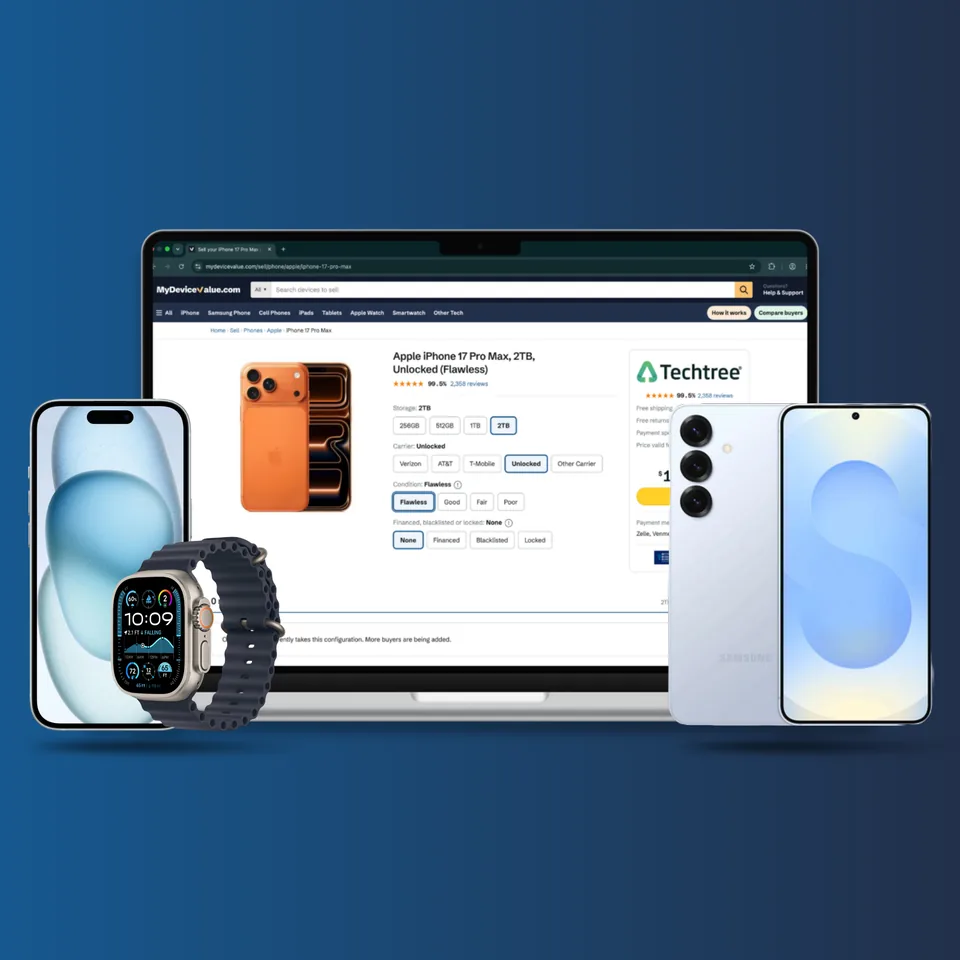
We do not buy your device. We compare what 2 vetted buyers will pay for it and rank them by payout, highest first, so you pick the best offer instead of the first one you find.
Free to sell
Nothing to pay us. No listing fee, no commission, no cut of your payout.
Prices you can hold
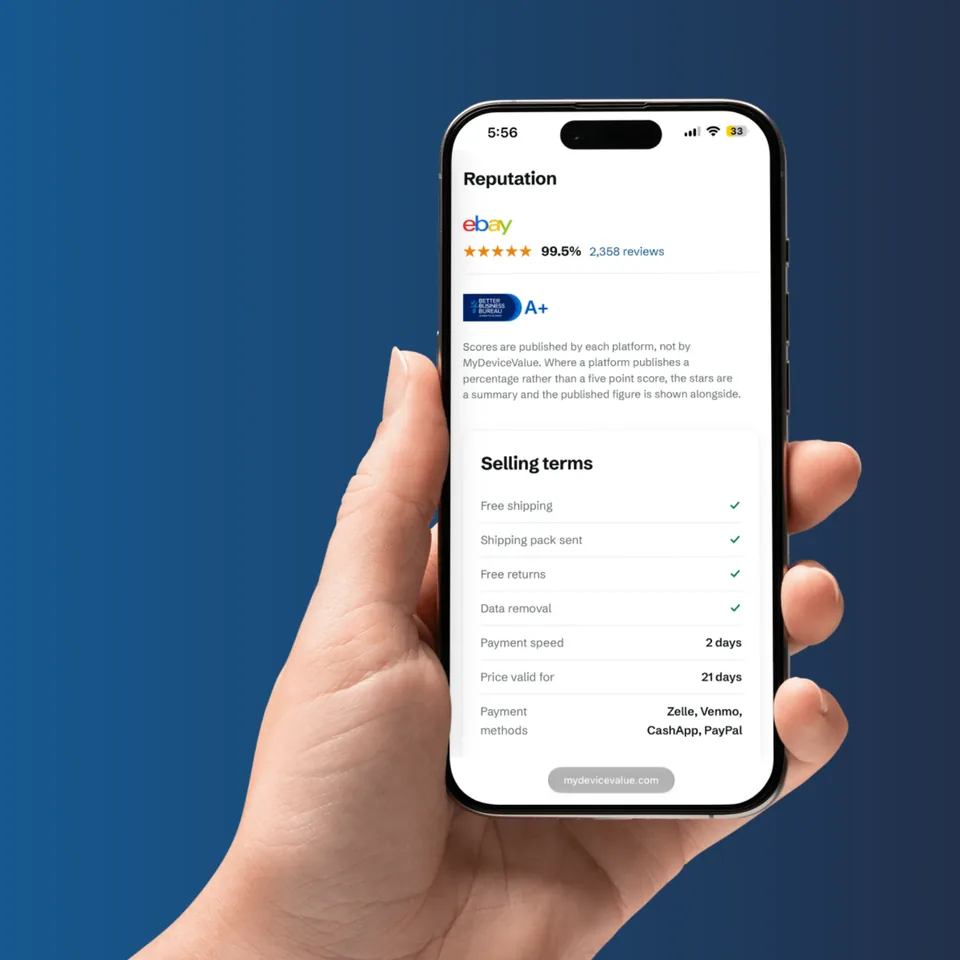
Each buyer holds your quote for a set window, shown with the offer.
Buyers worth trusting
Every buyer is checked before it is listed, and the terms are on the page.
How do you decide which buyer ranks first?
Purely by what they pay for your exact configuration, highest first. No buyer pays for placement and the order is never changed for commercial reasons. Buyers pay us a referral fee when a sale completes, which changes neither your payout nor the order.
Who handles the sale after I choose an offer?
The buyer does. We compare offers and send you to them, then the sale, shipping, inspection and payment all happen on their site under their terms.
Do these grades match the buyer's own conditions?
Not always. Our four grades exist so buyers can be compared on one scale, but each buyer sets and applies its own criteria. Check that buyer's condition requirements on their site before you complete the sale, because their grading is what determines your final payment.
Common questions
What sellers ask before posting phones to a buyer.
Carrier lock, IMEI and eSIM
On an iPhone running iOS 14 or later, open Settings, General, About and read the Carrier Lock line. No SIM restrictions means unlocked, and a carrier name means the phone is locked to that carrier. Apple states that only the carrier that locked a device can unlock it. Android wording varies by manufacturer, so the reliable test is a SIM from another carrier, or asking the carrier. Carrier lock is separate from Activation Lock and from blacklist status, and it is one of the options when you compare phone offers.
Policies differ by carrier, and between postpaid and prepaid, so confirm on the carrier's own unlock page before relying on any timeline. As published, T-Mobile postpaid requires a device it sold, active at least 40 days and paid in full, and AT&T postpaid requires a purchase 60 or more days ago and paid in full. Verizon changed its postpaid unlock policy in 2026, so check its current terms. Prepaid waits are much longer, and all three also require that the device is not reported lost, stolen or blocked.
Dial *#06# on the keypad of any phone and the IMEI displays immediately. You can also find it on an iPhone under Settings, General, About, and on Android under Settings, About phone, Status. Buyers use the IMEI to check blacklist, carrier lock and finance status before paying. Dual SIM and eSIM devices can report more than one IMEI, so confirm which one the buyer's form wants. MDV does not run IMEI checks and does not hold IMEI data, that check happens on the buyer's site.
Apple states that when you sell, trade in or give away a device that uses eSIM, you should erase the eSIM, and Erase All Content and Settings asks whether to erase or keep it. Choose erase when you are selling. Your number lives on the carrier account rather than on the eSIM profile, so deleting the profile does not by itself cancel service. Move the line to your new device, or arrange the transfer with your carrier, before you erase the old one.
Order matters: back up first, then remove accounts, then factory reset. Resetting first is what causes trouble, because with accounts still signed in the phone asks for the previous owner's credentials after reset and the buyer cannot set it up. Remove the Google account and any manufacturer account, such as a Samsung account, in Settings before you reset. Google calls this Factory Reset Protection, and Samsung documents it as Google Device Protection. Take out the SIM and any memory card before shipping, and check your maker's support page, since menu paths differ.
Battery condition is one input into a buyer's assessment, not a separate grade. On an iPhone the figure is in Settings, Battery, Battery Health and Charging. Buyers differ: some reduce the payout below a threshold, some reject a device below a threshold, and some do not adjust at all because they replace the battery anyway. Published thresholds and reduction amounts vary by buyer, so there is no general rule to state. A device with a non genuine replacement battery may also be assessed differently.
How MDV works, and who does what
Offers are ordered by payout for the exact configuration you selected, highest first. No buyer pays for placement, and the order is never changed for commercial reasons. Buyers pay MDV a referral fee when a sale completes, and that fee changes neither what you are paid nor where an offer sits in the list.
The buyer does. MDV compares published offers and hands you off to the buyer's own site, where shipping, inspection, revised offers, returns and payment all happen under that buyer's terms. MDV never receives, inspects, wipes or pays for a device. Terms differ from one buyer to the next, so read the buyer's own page before you ship anything.